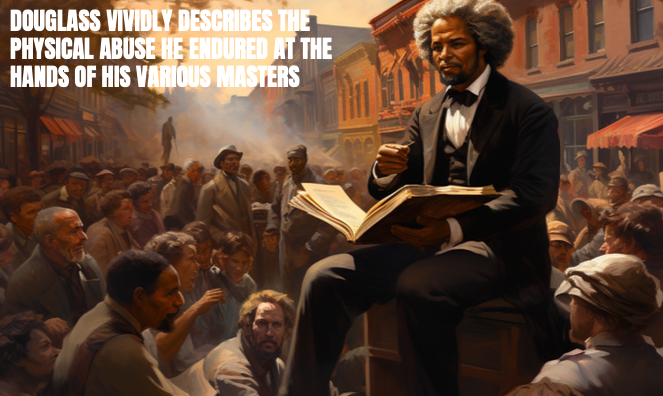
Frederick Douglass was born into slavery in Maryland around 1818, separated from his mother as an infant — a common cruelty designed to break the bonds that might one day fuel resistance. He never knew his exact birthday. Like millions of others, he was counted as property before he was ever counted as a person.
But one act of defiance would change the course of his life, and the country's.
The forbidden power of reading
As a boy sent to work in Baltimore, Douglass began to learn his letters from the wife of his enslaver — until her husband forbade it, warning that literacy would make an enslaved person "unmanageable" and "discontented." Douglass never forgot those words. He later wrote that in that moment he understood the secret his enslavers were trying to keep:
"Knowledge unfits a child to be a slave." Reading, he realized, was the pathway from slavery to freedom.
He kept learning in secret — trading bread to poor white children for lessons, studying discarded newspapers, practicing letters wherever he could. Every word he mastered was an act of rebellion.
Escape to freedom
In 1838, disguised as a sailor and carrying borrowed identification papers, Douglass boarded a train heading north. Within a day he was in New York City — a free man. He soon settled in Massachusetts, married Anna Murray, who had helped fund his escape, and took a new surname to elude slave catchers. The frightened runaway had become a free citizen. He would spend the rest of his life making sure others could do the same.
The Narrative that stunned a nation
Douglass became a spellbinding speaker on the abolitionist circuit — so eloquent that skeptics accused him of never having been enslaved at all. His answer, in 1845, was to publish the whole truth: the Narrative of the Life of Frederick Douglass, an American Slave. He named names, places, and dates, describing in unflinching detail the beatings, the hunger, and the psychology of bondage.
It was a sensation — and a risk. By identifying himself so precisely, Douglass made himself a target for recapture, and for a time he fled to Britain, where supporters purchased his legal freedom. The book sold tens of thousands of copies and became one of the most influential works of the abolitionist era, a firsthand testimony no defender of slavery could easily dismiss.
His story, beautifully illustrated.
Frederick Douglass is one of the towering figures brought to life in The History of Black History, Vol. 1 — alongside Tubman, Truth, and Du Bois.
Get it on Amazon →
Statesman of freedom
Douglass founded his own antislavery newspaper, The North Star, taking as its motto: "Right is of no sex — Truth is of no color." During the Civil War he pressed President Lincoln to make emancipation a war aim and to enlist Black soldiers, and he recruited them himself — two of his own sons among them. After the war he championed the rights of the freedpeople, the vote, and women's suffrage, becoming one of the most photographed and respected Americans of his age.
When he died in 1895, he had lived to see slavery abolished — the very institution that had tried to erase him before he could speak.
Why he still speaks to us
Frederick Douglass proved that the mind is the one thing bondage can never fully chain. He turned literacy into liberation, testimony into a movement, and his own life into an argument the nation could not ignore. That is why his words still ring in classrooms and courtrooms today — and why his story stands at the heart of The History of Black History.