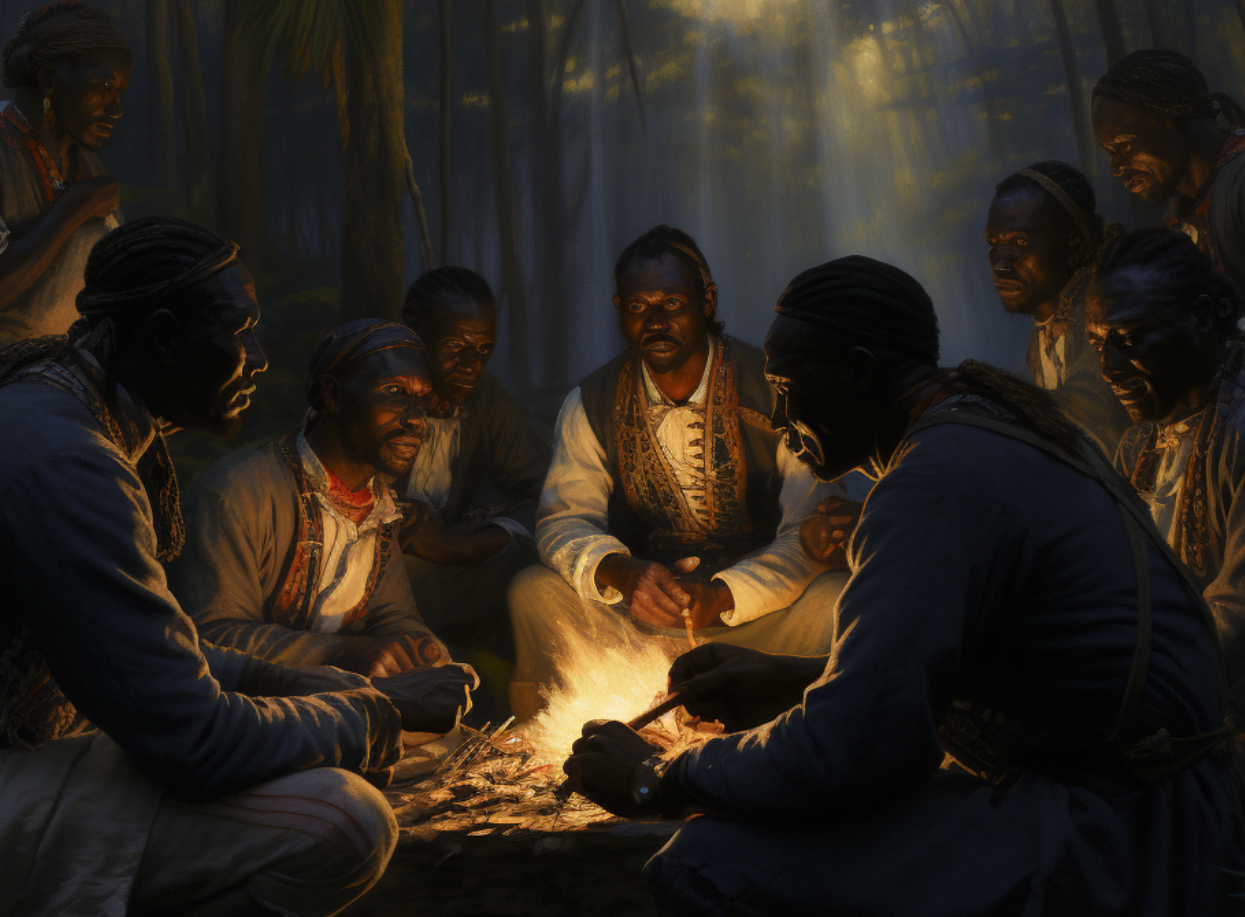
Saint-Domingue was the most profitable colony in the world. The French half of the island of Hispaniola produced a staggering share of the sugar and coffee consumed in Europe — wealth wrung out of the bodies of roughly half a million enslaved Africans under conditions so brutal that the enslaved population had to be constantly replenished. It was, by any measure, a machine of profit and death.
And in August 1791, that machine broke.
A revolution begins
The ideas of the age — liberty, equality, the rights of man — were sweeping across France and its colonies. But the enslaved of Saint-Domingue did not wait to be granted freedom by a distant assembly. They took it. A massive uprising erupted in the colony's north, and within weeks the revolt had grown into something no one could contain.
Out of that chaos rose a leader the world would never forget: Toussaint Louverture.
The making of a general
Born into slavery, Toussaint was self-educated, brilliant, and disciplined. He understood war, diplomacy, and the deadly chessboard of empire — France, Spain, and Britain all had designs on the island. Toussaint out-maneuvered them all. He built the ragged rebellion into a formidable army, defeated the professional soldiers sent to crush it, and for a time governed the colony himself.
He turned a revolt of the enslaved into a revolution of a people — and made the impossible look, for a moment, like destiny.
Toussaint's genius was not only military. He grasped that freedom, to endure, needed institutions — order, agriculture, a functioning society that no one could dismiss as mere anarchy. He was building a nation before it had a name.
Betrayal and independence
Napoleon Bonaparte, determined to restore both French control and slavery, sent an enormous expedition to retake the colony. Toussaint was lured into negotiations, seized, and deported to France, where he died in a cold prison cell in 1803 — never seeing the freedom he had fought for.
But the revolution did not die with him. His lieutenants, led by Jean-Jacques Dessalines, fought on — and, aided by yellow fever that devastated the French troops, they won. On January 1, 1804, they declared independence and gave the nation a name drawn from its Indigenous past: Haiti.
It was the first free Black republic in the world, and the second independent nation in the Americas.
The full story — illustrated.
The Haitian Revolution is one of more than 25 pivotal moments brought vividly to life in The History of Black History, Vol. 1.
Get it on Amazon →
The shockwave
Haiti's victory terrified slaveholding nations and inspired the enslaved everywhere. It proved that freedom could be taken, not merely begged for — and the powers that profited from slavery punished the young nation for the crime of its own liberty, isolating and indebting Haiti for generations. The price of that first freedom was steep, and Haiti is still paying it.
Yet the fact remains, undimmed by two centuries: an enslaved people looked at the greatest empire of their day and refused to accept that their chains were permanent. That refusal is one of the most important stories in all of Black history — and it belongs at the center of how we remember it.