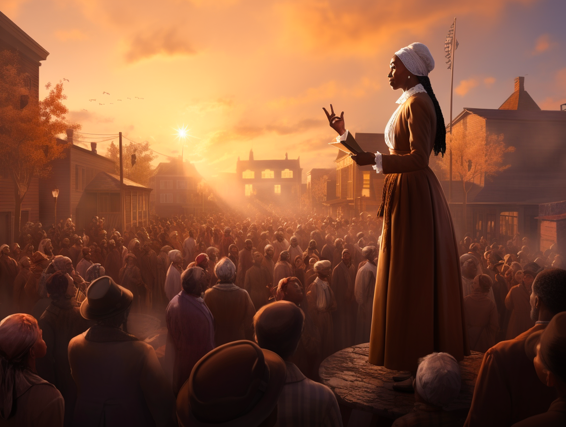
She was born Isabella Baumfree, somewhere around 1797, into the grinding cruelty of enslavement in New York's Hudson Valley. She did not choose her name, her owners, or the language she would first learn to speak — Low Dutch, the tongue of the Dutch colonists who held her. She was bought and sold, separated from her family, and subjected to the full brutality that American slavery inflicted on Black women in particular: labor without limit, dignity without protection, motherhood without security. And yet, from those origins, she built one of the most remarkable lives in the history of this nation.
From Isabella Baumfree to Sojourner Truth
New York's gradual emancipation law finally freed Isabella in 1827, but legal freedom and true liberation are never the same thing. She moved to New York City, worked as a domestic servant, and began the spiritual journey that would define her public identity. In 1843, she experienced what she described as a divine calling. She walked away from her given name — a name that had belonged, in a sense, to the people who had enslaved her — and rechristened herself Sojourner Truth. The name was a declaration of purpose: she would sojourn, travel the land, and speak truth wherever she went. She kept that promise for the remaining four decades of her life.
Unable to read or write — literacy having been systematically denied to enslaved people — Sojourner dictated her life story to a friend, Olive Gilbert. The resulting work, The Narrative of Sojourner Truth, was published in 1850, just one year before her most famous moment on a public stage. That she could not hold a pen did not diminish the force of her mind or the precision of her tongue. In a culture that equated literacy with intelligence, she demolished that assumption every time she opened her mouth.
The Convention at Akron
The Women's Rights Convention held in Akron, Ohio, in May 1851 was a tense gathering. The women's suffrage movement was young and fragile, and many of its white participants were deeply anxious about associating their cause too closely with the abolitionist movement. Some feared that linking the two struggles would alienate potential supporters. The room, by most accounts, was charged with nervousness when Sojourner Truth rose to speak — and not everyone in it was glad to see her do so.
She spoke without notes, without preparation in the formal sense, drawing instead on the unimpeachable authority of her own experience. She pointed to her own hands — hands that had plowed fields, planted crops, and hauled loads no man in that room had ever been asked to carry — and demanded that those present reckon with the full meaning of womanhood.
The speech she delivered that day was extemporaneous, shaped in the moment by the crowd's energy and by the arguments she had just heard from the floor. It has come down to history under the title Ain't I a Woman? — though scholars are careful to note that the now-iconic phrasing appears in a transcription published more than a decade later, rather than in the earliest recorded version of her words. What is not in dispute is the force of her central argument: that the elevated, fragile, protected version of womanhood being debated by white suffragists had never been extended to her, and that her survival and strength proved the argument for women's equality more powerfully than any parlor-room philosophy could.

See this history — beautifully illustrated.
This story and dozens more come to life in The History of Black History, Vol. 1 by C. Foskey.
Get it on Amazon →
A Body as Evidence
What made Sojourner Truth's argument so devastating — and so difficult to dismiss — was its radical simplicity. She did not appeal to abstract natural rights, though those arguments were available to her. She appealed to her own body and her own history. She had worked as hard as any man. She had borne children and watched them taken from her. She had never been sheltered from hardship or lifted over a mud puddle by a chivalrous hand. If womanhood required delicacy and dependence, she asked, then what had she been all these years? And if she had clearly been a woman all along — if no one in that room could seriously argue otherwise — then every justification for denying women equal rights collapsed under the weight of her testimony.
This was not merely rhetoric. It was a philosophical intervention that anticipated, by more than a century, what scholars would eventually call intersectionality: the recognition that race, gender, and class do not operate in isolation, that a movement for women's rights that ignores the experiences of Black women is a movement that has not yet understood its own subject. Sojourner Truth was not a theorist in the academic sense, but she was a thinker of the first order, and the clarity of her analysis in that Akron church remains startling even today.
A Life Larger Than One Speech
It would be a disservice to Sojourner Truth to reduce her to a single moment, however luminous. She continued to travel, speak, and agitate for the rest of her long life. During the Civil War, she recruited Black soldiers for the Union Army, understanding before many of her contemporaries that the war's outcome would determine the future of her people. In 1864, she met President Abraham Lincoln at the White House — a formerly enslaved woman, a self-renamed prophet, sitting with the president during the nation's most convulsive hour. After the war, she worked tirelessly on behalf of freedpeople, advocating for land grants, education, and resettlement programs that might give the formerly enslaved a genuine foundation for self-sufficiency rather than a freedom that existed only on paper. She died in Battle Creek, Michigan, in 1883, having never stopped sojourning, never stopped speaking truth.
Why It Still Matters
As C. Foskey traces in The History of Black History, Vol. 1, the stories we recover from this era are not simply museum pieces. They are active arguments about who belongs in the American story and who has always had to fight to be counted within it. Sojourner Truth's life — from Isabella Baumfree, a child with no legal claim to her own name, to a woman who stood before presidents and packed auditoriums alike — is a testament to what human beings are capable of when they refuse the identities forced upon them.
Her 1851 speech endures not because it was polished or credentialed, but because it was true. She brought into that Akron church something no pamphlet could replicate: the unassailable evidence of a life fully and fiercely lived. When we read her words today — in whatever transcription, whatever version has survived — we are encountering a woman who understood that the most powerful argument for justice is the one that cannot be theorized away, the one that stands up, looks the room in the eye, and simply tells the truth about what happened.
That, in the end, is what Sojourner Truth did. And the room — and history — has never quite recovered.